Many CED organizations report rising demand on their services. Few can use data well enough to show their impact. Here’s how Budget 2026 lines up with what we’ve heard from the CED field.
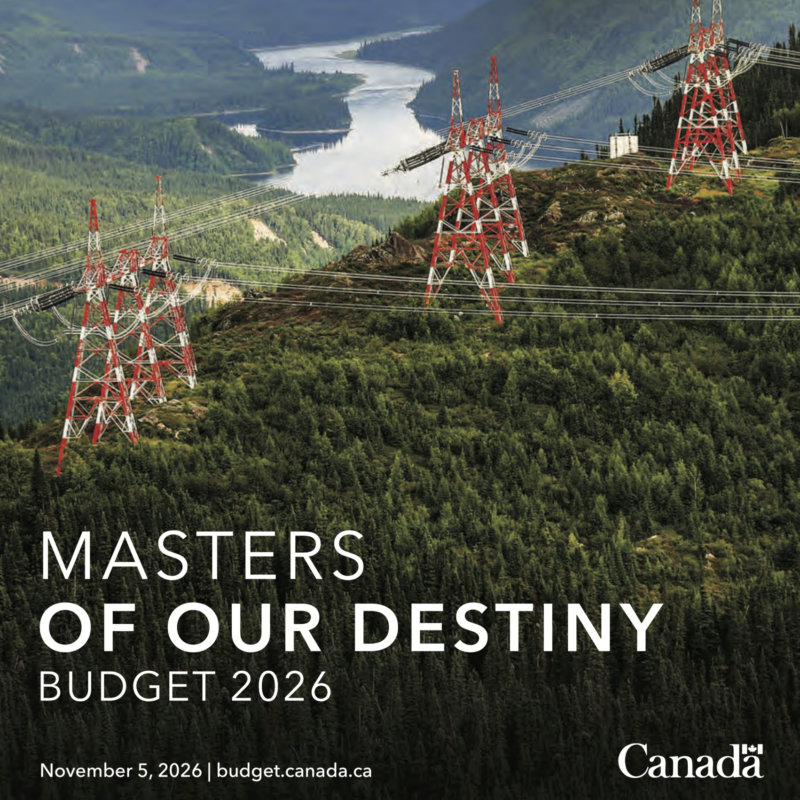
On November 5, 2026, Finance Minister François-Philippe Champagne delivered the Government of Canada’s 2026 federal budget, Masters of Our Destiny. This new budget presents significant potential investment in Canada’s community economic development (CED) field, particularly in the areas of affordable housing, social enterprise, local economic resilience, workforce development, Indigenous economic participation, and community infrastructure.
The dominant economic narrative in the budget is of investment, productivity, sovereignty and growth. With government spending the question is always who will benefit the most? And, will communities—and the social enterprises, co-operatives, non-profits, Indigenous organizations and CED practitioners that work for and within them—have the resources, opportunities and decision-making authority to participate and benefit meaningfully?
While the significant commitments towards combatting poverty, homelessness and food insecurity are welcome, there needs to be a corresponding commitment by the Government of Canada to support approaches that position those experiencing poverty, homelessness and food insecurity as masters of their own destiny. Communities cannot simply be the locations where investment occurs, but active participants in shaping, directing, owning and benefiting from investment.
Community economic development organizations (such as social enterprises, co-operatives, community land trusts, etc.) are essential partners in translating national investment into lasting local prosperity, not just by providing valuable goods and services but by providing the supports and opportunities for community members to develop employment and leadership skills.
We recently completed a needs assessment of the CED field and couldn’t help but notice how our findings matched up against what was in the 2026 federal budget. Here’s what we’re seeing.
The field is being asked to solve bigger problems
Our assessment found that 77% of respondents are experiencing increasing demand, particularly around housing, affordability, employment, food insecurity, and economic uncertainty. Budget 2026 makes substantial investments in many of these areas, including affordable housing, homelessness prevention, community infrastructure, and workforce development. The alignment is clear, but the question is whether community organizations will have the capacity and resources to participate meaningfully.
Community innovation is outpacing infrastructure
Our assessment found that 90% of respondents had launched new initiatives, but far fewer were developing new financing tools (18%) or community ownership models (8%). The budget emphasizes investment, productivity, and entrepreneurship, but there is less explicit attention to social enterprise, co-operatives, and community wealth building. Financing and policy mechanisms are needed that recognize different forms of ownership and economic participation.
Data is becoming strategic infrastructure
Only 18% of respondents indicated that they could sufficiently use and translate data to inform decisions and demonstrate impact. The budget places increasing emphasis on measurement, reporting, and digital transformation, including real-time reporting requirements for homelessness programming. The work being done by groups like the Community Data Program are critical components to community infrastructure moving forward.
The future is ecosystem development
Nearly half of respondents (49%) described themselves as minimally connected or disconnected from the broader CED field. The budget creates opportunities across housing, regional economic development, food systems, Indigenous economic participation, and workforce development. We view our network as a crucial ecosystem developer, helping to connect organizations across these areas, sharing emerging models, and supporting collaboration rather than having organizations navigate opportunities independently.
The field is entering a period of strategic choice
Our needs assessment found that 60% identified funding misalignment with operational realities as a policy gap. At the same time, 70% expressed interest in regional or thematic policy labs. The budget offers several opportunities for policy engagement, particularly around regional development agencies, community ownership, social enterprise eligibility, and infrastructure financing. The role of the Canadian CED Network is to bring forward evidence-based recommendations from the field to advance a people-centred economy as a significant component of economic sovereignty.
The underlying issue remains field capacity
While the budget commits significant resources to projects and infrastructure, our assessment shows that organizations are struggling with funding uncertainty, workforce pressures, and limited long-term capacity. Investment in communities is important, but so is investment in the organizations and networks that make community economic development possible.
What is in this budget, explicitly, that could bolster the CED field?
1. Affordable housing, homelessness and community-owned assets
| Budget item and page | What it means for the field |
| $11.2 billion over four years to address homelessness, with $17.8 billion in future years — pp. 197–199 | Significant opportunities for community housing providers, Indigenous organizations, non-profits and local service partnerships. |
| $1.8 billion Integrated Supports Fund over four years — p. 198 | Supports projects integrating housing, health, mental health, addictions and social supports. Relevant to community-led, integrated service models. |
| $3.6 billion for supportive and transitional housing over four years — pp. 198–199 | Potential for non-profit housing developers, community land trusts and mission-driven housing organizations to participate. |
| $2.1 billion to renew Reaching Home and the Veterans Homelessness Program, with additional future funding — p. 199 | Particularly important for local organizations delivering community-led homelessness prevention and support. |
| Renewal of the Canada Housing Benefit for 10 years — p. 199 | Helps low-income renters maintain stable housing, supporting broader community economic stability. |
| Expansion of non-market housing through Build Canada Homes — pp. 201–202 | Opportunities for non-profit, Indigenous and community housing partners to build, acquire and preserve affordable housing. |
2. Community infrastructure and place-based economic development
| Budget item and page | What it means for the field |
| Build Communities Strong Fund: $51 billion over 10 years, plus $3 billion annually ongoing — pp. 204–205 | Investment in recreation centres, health facilities, educational institutions, water systems and other community infrastructure. |
| Community infrastructure projects across provinces and territories — pp. 205–206 | Identified projects include community centres, cultural facilities, recreation spaces and community-serving organizations. |
| Housing-enabling infrastructure — pp. 204–207 | Supports the infrastructure required for housing development and community growth. |
3. Regional economic development and small business resilience
| Budget item and page | What it means for the field |
| Greater flexibility for regional development agencies — p. 180 | Agencies will have more flexibility to tailor support to smaller businesses and organizations responding to regional economic conditions. |
| Support for businesses and workers affected by trade disruption — pp. 175–179 | Potential benefits for regional development organizations, community businesses and enterprises affected by tariffs and market changes. |
| Building one Canadian economy — pp. 180–181 | Reduced interprovincial barriers may create opportunities for local businesses and co-operatives operating across provincial boundaries. |
4. Local food systems and food security
| Budget item and page | What it means for the field |
| $124 million over three years to renew the Local Food Infrastructure Fund — p. 208 | Supports food banks and other organizations investing in community food infrastructure. |
| National Food Security Strategy — pp. 208–209 | Creates opportunities across local food production, processing, distribution and food-system resilience. |
| Support for independent grocery competition — p. 208 | Potential benefits for locally owned grocers and community-based food distribution models. |
5. Workforce development, skills and inclusive employment
| Budget item and page | What it means for the field |
| Team Canada Strong skilled trades initiative — pp. 213–214 | Opportunities for community-based employment organizations and training partnerships, including programs serving women and underrepresented workers. |
| $451.8 million over four years for the Partnerships for Indigenous Workforce Readiness Fund, plus ongoing support — p. 215 | Supports Indigenous-led skills and employment training and partnerships. |
| $170 million for the Workforce Tariff Response in 2027–28 — pp. 215–216 | Supports training and employment services for workers affected by tariffs and trade disruptions. |
| Expanded Employment Insurance support for apprentices in full-time training — p. 214 | Helps reduce financial barriers for apprentices entering skilled trades. |
6. Indigenous economic reconciliation, ownership and self-determination
| Budget item and page | What it means for the field |
| Housing and infrastructure in First Nations communities — pp. 237–241 | Supports community assets, infrastructure development and long-term local economic conditions. |
| Strengthening Indigenous governments’ fiscal and institutional capacity — p. 243 | Relevant to Indigenous-led development, institutional capacity and economic self-determination. |
| Partnership and ownership in economic development — p. 244 | Recognizes Indigenous participation and ownership in major economic projects. |
| $10 billion Indigenous Loan Guarantee Program, referenced in the budget — pp. 167–170, 244 | Supports access to financing for Indigenous equity participation in major projects. |
7. Equity, inclusion and economic participation
| Budget item and page | What it means for the field |
| $8 million over four years for the Women’s Program, plus $2 million ongoing — p. 245 | Supports organizations advancing gender equality, including women’s entrepreneurship, leadership and systemic barrier reduction. |
| $136.3 million over four years for Canada’s Black Justice Strategy — p. 246 | Includes community-based initiatives, Black-led organizations, reintegration services and employment opportunities for Black youth. |
| Renewal of the 2SLGBTQI+ Project Stream — p. 247 | Supports organizations working to address systemic barriers and strengthen inclusion. |
| $70 million over two years for the Menstrual Equity Fund — p. 245 | Supports access to essential products and community-based education and distribution. |
8. Social enterprise, co-operatives and SMEs
| Budget item and page | What it means for the field |
| Canada Growth Incentive — pp. 115–116 | Encourages reinvestment of eligible capital gains into Canadian start-ups. Primarily relevant to conventional growth-oriented enterprises. |
| Innovation and commercialization measures — pp. 115–119 | Potential opportunities for innovative social enterprises, depending on eligibility. |
| Productivity Mega Deduction — pp. 111–115 | Benefits eligible businesses making qualifying capital investments; not automatically applicable to non-profit organizations. |
| More flexible regional development programming — p. 180 | Potential opening for smaller community businesses and organizations. |
9. Climate resilience and energy affordability
| Budget item and page | What it means for the field |
| $2 billion investment in retrofitting one million homes — p. 193 | Opportunities for community-based retrofit programs, energy efficiency services and local employment. |
| National Electricity Strategy — pp. 123–132 | Major investments in electricity infrastructure and clean energy. |
| Clean technology and sustainable investment measures — pp. 138–141 | Potential opportunities for community enterprises operating in climate-related sectors. |
For further reading:
- Budget 2026: Masters of our destiny
- Budget 2026 Opens Door to Capitalizing Communities but Does Not Walk Through It – The Community Resilience Campaign’s budget response
- Canada’s Budget 2026: What it Means for Communities in Canada – Tamarack Institute’s budget response and December 9th webinar
- Budget 2026: Building a stronger Canadian economy starts in our communities – Canada Co-op’s budget response
- Budget 2026 measures for nonprofits focus on administrative streamlining with targeted investments in key areas – Imagine Canada’s budget response